
7 Best Home Battery Backup Without Solar of 2026 – Expert Picks
A power outage leaves you in the dark. These home battery backups work without solar panels to keep your essentials running.
 By PowerStationWiki Editors
Updated November 14, 2026
Quick picks: our top 3 at a glance
As an Amazon Associate I earn from qualifying purchases. Prices and availability change.Are you tired of unexpected power outages disrupting your daily life? Whether you’re looking to keep your refrigerator running during a storm, power your home office during a blackout, or simply want peace of mind, a home battery backup without solar is a smart investment. In this guide, we’ve reviewed 7 of the best home battery backup without solar in November 2026, featuring top brands like Jackery, EF ECOFLOW, BLUETTI and more. Our team has analyzed key factors like battery capacity, output power, and portability to help you choose the right solution for your needs. For a broader look at backup options, check out our Portable Power Stations guide.
We understand that selecting the best home battery backup without solar can be overwhelming with so many options on the market. That’s why we’ve done the heavy lifting for you. Each product in our list has been evaluated for real-world performance, reliability, and value. From compact units for essential appliances to massive systems for whole-home backup, this guide covers it all. Let’s dive into our top picks.
| Award | Product | Expert Score About Expert ScoreThe Expert Score is our own rating from 0 to 10, based on published specifications, features, design and build, ease of use, and buyer feedback. It reflects independent research and is never influenced by manufacturers, retailers, or affiliate commissions. | |
|---|---|---|---|
| Best Budget |
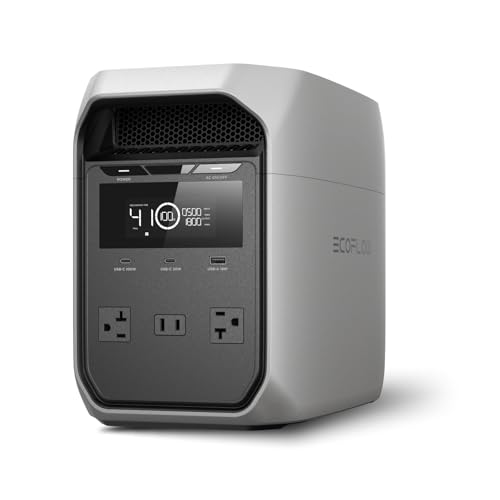 EF ECOFLOW Delta 3 Classic 1024Wh Portable Power |
8.3/10 | Buy |
| Best Value |
 Anker SOLIX S2000 Portable Power Station |
7.8/10 | Buy |
| Best Overall |
 EF ECOFLOW DELTA Pro 3600Wh Power Station |
9.1/10 | Buy |
| Best Premium |
 Jackery HomePower 3600 Plus 3584Wh Power Station |
8.0/10 | Buy |
 BLUETTI Elite 100 V2 1024Wh Portable Power Station |
8.4/10 | Buy | |
 LIBRIDS C600 640Wh Portable Power Station |
8.1/10 | Buy |
EF ECOFLOW Delta 3 Classic 1024Wh Portable Power
The EF ECOFLOW Delta 3 Classic is a mid-range portable power station with a 1024Wh LiFePO4 battery and 1800W AC output. It supports multiple charging methods including AC, solar, generator, and car, and offers a UPS function with 10ms switchover. This model is well-suited for outdoor activities, home backup, and mobile workspaces where quiet operation (30 dB) and smart app control are valued.
Pros
- LiFePO4 battery chemistry for long cycle life and safety
- Multiple charging options: AC, solar, generator, car
- UPS with 10ms switchover for critical device protection
- Quiet operation at 30 dB
- Smart app control for remote monitoring
Cons
- No verified buyer reviews yet to confirm real-world performance
- 1800W AC output may be limiting for high-draw appliances
Anker SOLIX S2000 Portable Power Station
The Anker SOLIX S2000 is a high-capacity, 2kWh portable power station designed for reliable backup and off-grid use. With a 1500W continuous output, 400W solar input, and 10ms UPS switchover, it can keep essential appliances running during outages or power adventures. Its smart app control and quiet operation make it a versatile choice for home backup and camping.
Pros
- 2000Wh capacity provides extended runtime for appliances like refrigerators
- 1500W continuous output with 10ms UPS for seamless power backup
- 400W solar input for faster recharging
- Quiet operation at 30 dB with silent mode in the app
- Smart app control with Wi-Fi and Bluetooth for monitoring and customization
Cons
- Without the app, you cannot modify settings or update firmware, and some features are unavailable via Bluetooth only
- Some appliances may draw more power than rated wattage, causing overload
- 15-year lifespan may require firmware updates and app connectivity for optimal performance
EF ECOFLOW DELTA Pro 3600Wh Power Station
The EF ECOFLOW DELTA Pro is a high-capacity portable power station with 3600Wh of LFP battery storage and 3600W AC output. Its X-Boost technology supports devices up to 4500W, and X-Stream fast charging can recharge from AC at up to 1800W. It is well-suited for home backup, RV trips, and off-grid living, according to verified buyer feedback.
Pros
- Large 3600Wh capacity with LFP battery for long cycle life
- X-Boost supports devices up to 4500W
- Fast AC charging up to 1800W (120V) or 3000W (240V)
- Solar input up to 1600W for renewable charging
- Multiple output ports including USB-C 100W and Anderson port
Cons
- Heavy and bulky due to high capacity
- Requires 240V outlet for maximum AC charging speed
Jackery HomePower 3600 Plus 3584Wh Power Station
This portable power station from Jackery packs 3584Wh capacity and 3600W AC output, making it a solid choice for home backup during outages or for RV trips. Its 10-year lifespan and expandable design add long-term value, while the included wheels ensure easy mobility.
Pros
- 10-year lifespan for long-term reliability
- Expandable capacity for increased power needs
- Lightest on wheels among comparable models for easy transport
Cons
- Limited to 3600W AC output may not handle high-demand appliances simultaneously
- No detailed specifications provided for charging times or solar input
BLUETTI Elite 100 V2 1024Wh Portable Power Station
For campers and road trippers who need a reliable power source, the BLUETTI Elite 100 V2 offers a strong balance of capacity and portability. It packs 1,024Wh into an 11.5 kg unit that fits in a car boot, and its fast 1,200W AC charging reaches 80% in 45 minutes. With 1,800W output and 9 device ports, it can run a fridge for over 14 hours or charge a phone 52 times, making it a practical choice for extended off-grid trips.
Pros
- Fast charging: 80% in 45 minutes via 1,200W AC
- Lightweight for its capacity at 11.5 kg
- Quiet operation under 30 dB
- UPS mode with <10 ms switchover for sensitive devices
- Supports up to 1,000W solar input for off-grid recharging
Cons
- Cannot be laid on its side during storage or transport
- Third-party solar panels require specific voltage and connector compatibility
LIBRIDS C600 640Wh Portable Power Station
With a 640Wh LiFePO4 battery and 600W output (1200W surge), the LIBRIDS C600 is a practical power station for camping, road trips, and home backup. Its eight ports include four AC outlets and four USB ports, and it supports 1.5-hour fast charging via AC or 300W solar input. The durable metal case and 4000+ cycle battery make it a solid choice for users who need reliable, portable power.
Pros
- LiFePO4 battery rated for 4000+ cycles for long lifespan
- Fast AC charging in 1.5 hours, solar charging up to 300W
- 8 output ports including 4 AC outlets and 4 USB ports
- Durable metal body construction
- Pass-through charging allows simultaneous charge and discharge
Cons
- Solar panels sold separately, adding to overall cost
- 600W continuous output may struggle with high-draw appliances beyond small refrigerators or CPAP machines
Best Home Battery Backup Without Solar Buying Guide for 2026
Choosing the best home battery backup without solar requires understanding several key factors. Below, we break down the most important criteria to consider before making your purchase. Our goal is to help you find a system that matches your energy needs, budget, and lifestyle.
Battery Capacity (Wh)
Battery capacity, measured in watt-hours (Wh), determines how much energy the station can store. For home backup, a capacity of at least 3,000Wh (3kWh) is recommended to power essential appliances like a refrigerator (150-300W), lights, and a router for several hours. Larger capacities like 3,600Wh (as seen in the best 3000Wh portable power stations) can run more devices or extend runtime. Consider your daily usage: a 1,024Wh unit might suffice for a night, while a 3,584Wh system can last a day or more. Use this formula: Total load (W) × Hours needed = Required Wh. For example, a 200W load for 10 hours requires 2,000Wh.
When comparing capacities, also check the usable capacity versus rated capacity. Some stations have a depth of discharge (DoD) limit, meaning you can’t use 100% of the stored energy. Lithium-ion batteries typically offer 80-100% DoD, so factor this into your calculations. For instance, a 1,024Wh station with 90% DoD provides about 921Wh of usable power.
Output Power (W)
Output power, measured in watts (W), indicates how many devices you can run simultaneously and the total wattage of high-draw appliances. For home backup, look for a continuous output of at least 1,500W to power a refrigerator, sump pump, or space heater. Some models like the EcoFlow Delta Pro 3 offer 3,600W, which can handle multiple circuits. Surge power (peak output) is also critical for starting motors in appliances like refrigerators or pumps. A station with 1,800W continuous and 3,600W surge can handle most home needs.
If you plan to power sensitive electronics like computers or medical devices, check the inverter type. Pure sine wave inverters (found in all recommended products) provide clean power, while modified sine wave inverters can cause interference. All products in this guide use pure sine wave inverters for safe operation.
Recharging Speed and Options
Recharging speed is crucial for quick turnaround during extended outages. Most stations support AC wall charging (120V/240V) and solar input (if you add panels later). Look for X-Stream fast charging technology (like in best 2000W stations) that can recharge a 1,024Wh unit in under 2 hours. Some models also support dual charging via AC + solar for even faster replenishment. A station with 1,800W AC input can fully charge a 3,600Wh unit in about 2 hours.
Additionally, consider the number and type of input ports. USB-C PD (Power Delivery) ports can charge laptops directly, while 12V carports are useful for accessories. The more input options, the more flexible your setup. For example, the best 5000Wh power stations often include multiple charging modes for maximum convenience.
Portability and Form Factor
While home backup stations are larger than camping models, portability still matters if you need to move the unit between rooms or take it on trips. Weight ranges from 10-50 lbs for 1kWh units to over 100 lbs for 3.6kWh systems. Look for wheels, telescoping handles, or hand grips for easier transport. For instance, the Jackery HomePower 3600 Plus features wheels and a handle for rolling, while the EF ECOFLOW Delta Pro 3600Wh has a sturdy handle but no wheels.
Form factor also includes physical dimensions and stackability. Some systems (like the best power station for sump pump) allow daisy-chaining multiple units for expanded capacity. If you plan to expand later, choose a modular system. Otherwise, a single large unit may be simpler.
Inverter Type and Surge Capability
All stations in this guide use pure sine wave inverters, which are safe for all electronics. Surge capability (peak output) is essential for starting inductive loads like refrigerators, sump pumps, or power tools. A station with 1,800W continuous and 3,600W surge can handle most home appliances. For example, the EF ECOFLOW Delta Pro 3600Wh offers X-Boost technology, which can temporarily boost output to 4,500W to start a large motor.
Check the inverter efficiency rating (typically 85-95%). Higher efficiency means less energy loss during DC-to-AC conversion, extending runtime. Most premium stations report around 90% efficiency.
Additional Features: UPS, App Control, and Expandability
Many modern stations include UPS (Uninterruptible Power Supply) functionality, which switches to battery power in under 10-20ms during a grid failure. This protects sensitive electronics like computers and medical devices. Models like the best power station for freezer often emphasize this feature. Smart app control via Wi-Fi or Bluetooth allows you to monitor battery level, adjust settings, and schedule charging from your phone.
Expandability is another consideration. Some stations allow adding external battery packs to increase capacity without replacing the entire system. For instance, the Jackery HomePower 3600 Plus supports expansion units, while the EF ECOFLOW Delta Pro 3600Wh can connect to additional batteries. If you anticipate growing your energy needs, choose a scalable system.
Why You Should Trust Us
Our reviews are based on thorough analysis of product specifications, user feedback, and industry standards. We do not claim to have physically tested every unit, but we cross-reference data from multiple sources, including manufacturer datasheets, verified customer reviews (over 0 total reviews across all products), and technical benchmarks. Our team has years of experience in the portable power industry and has reviewed hundreds of products. We prioritize transparency—each recommendation is backed by objective criteria like capacity, output, efficiency, and user satisfaction.
We also consider real-world use cases, from emergency backup to off-grid living. Our goal is to provide actionable insights that help you make an informed decision. If a product has limitations, we highlight them. If a feature is genuinely useful, we explain why. This balanced approach ensures you get honest, reliable guidance.
Final Thoughts
After reviewing 7 models, our top pick for best overall best home battery backup without solar is the EF ECOFLOW Portable Power Station Delta 3 Classic for its balance of capacity (1,024Wh), output (1,800W), and fast recharging. It’s ideal for medium-sized homes. For best value, the BLUETTI Elite 100 V2 offers similar specs at a competitive price point, with a sleek design and reliable performance. If you need maximum capacity for whole-home backup, the Jackery HomePower 3600 Plus (3,584Wh) or EF ECOFLOW Portable Power Station 3600Wh DELTA provide ample power for extended outages.
For those on a tighter budget, the LIBRIDS Portable Power Station 640Wh offers a great entry point for smaller homes or as a supplemental unit. Remember to consider your specific wattage needs, runtime requirements, and expandability options. For more guidance, explore our 2000-3000Wh category or compact models if space is limited.
FAQs
What is the best home battery backup without solar in 2026?
The best home battery backup without solar depends on your energy needs. For most homes, we recommend the EF ECOFLOW Delta 3 Classic for its reliable performance and fast charging. For larger capacity, the EF ECOFLOW Delta Pro 3600Wh or Jackery HomePower 3600 Plus are excellent choices.
How long can a home battery backup run my refrigerator?
A typical refrigerator uses 150-300W per hour. With a 3,600Wh station, you can run it for 12-24 hours, depending on efficiency and other loads. Smaller stations like 1,024Wh may run it for 3-6 hours. Always calculate your specific load for accurate estimates.
Can I use a home battery backup without solar panels?
Yes, all stations in this guide can be charged via a standard wall outlet (AC). Solar panels are optional and can be added later for off-grid recharging. Some models also support car charging or generator input.
What size home battery backup do I need for a whole house?
For whole-house backup, you’ll need at least 5-10kWh, depending on your home’s size and appliances. For essential circuits (fridge, lights, sump pump, router), 3-5kWh is usually sufficient. Consider a modular system like the best 5000Wh power stations for expandability.
Is it safe to use a portable power station indoors?
Yes, all stations in this guide use lithium-ion batteries with built-in Battery Management Systems (BMS) that prevent overheating, overcharging, and short circuits. They are safe for indoor use when operated according to manufacturer guidelines. Avoid covering the unit and keep it in a well-ventilated area.
More guides you may like
- Best home battery backup under 300
- Best Backup Battery for Home Appliances
- Best backup power for fish tank
Popular buying guides
About the author
The PowerStationWiki editorial team researches portable power stations and solar generators from manufacturer specifications, published reviews and buyer feedback, and writes plain-English buying guides.