
How Many Solar Panels Do You Need to Charge a Power Station?
How many solar panels to charge a portable power station: the simple watt-hour maths, sun hours, panel input limits, voltage and connector compatibility.
 By Solar & Safety Desk
Updated November 14, 2026
This guide is based on manufacturer specifications, published information and buyer feedback. We do not claim hands-on testing. Always follow the instructions that come with your own equipment.
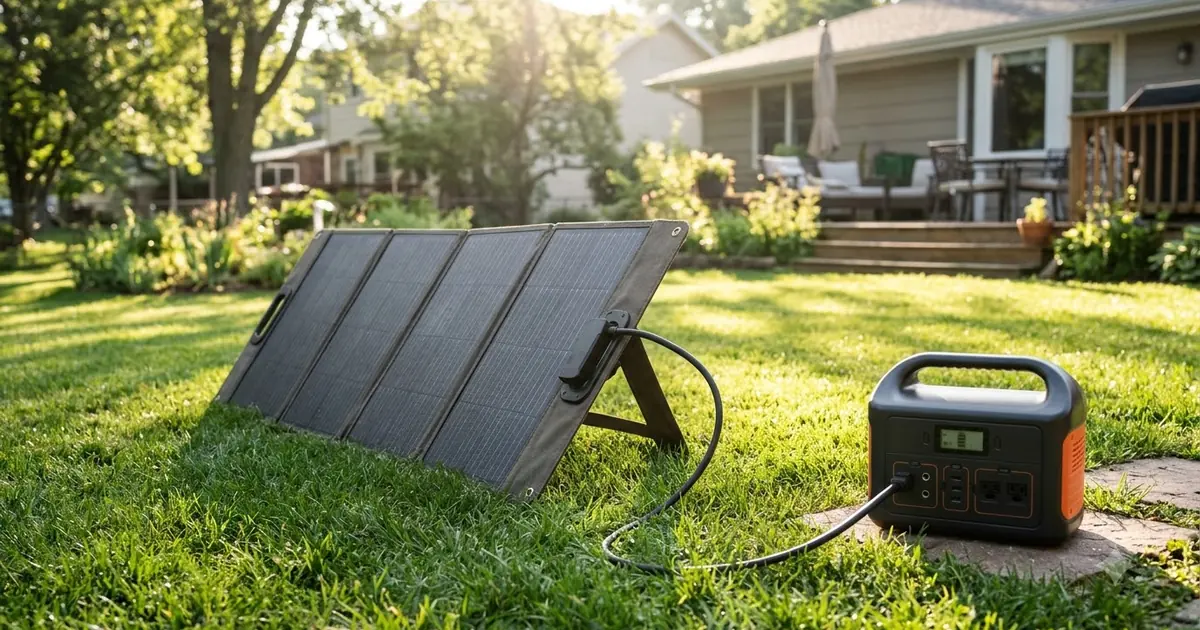
Charging a power station with solar is simple in principle, but the numbers decide whether it takes one day or three. This guide shows the maths and the compatibility checks.
The basic maths
Daily solar energy (Wh) = panel watts x peak sun hours x system efficiency. Peak sun hours are the hours per day with strong sunlight; many places in the US see roughly 4-6 on a good day. System efficiency is typically 0.7-0.8 once you allow for angle, heat and charging losses.
Example: a 200 W panel x 5 sun hours x 0.75 = about 750 Wh per day. To refill a 1,000 Wh power station from empty you would need about 1.3 such days, or two 200 W panels for roughly one day.
| Panel setup | Approx. daily energy (5 sun hours) |
|---|---|
| 100 W | About 375 Wh |
| 200 W | About 750 Wh |
| 400 W | About 1,500 Wh |
Check the power station’s solar input
- Maximum input watts. Extra panel power beyond the limit is wasted.
- Input voltage range. The panels’ combined voltage must stay inside the unit’s allowed range, especially in cold weather when voltage rises.
- Connector type. MC4, XT60, Anderson and DC barrel connectors are common. Use the correct adapter.
Series or parallel
Connecting panels in series raises voltage, in parallel it raises current. The right choice depends on the power station’s input limits. Follow the manual.
Placement tips
- Face the panels toward the sun and tilt them for the season.
- Keep shade off the panels, since partial shade cuts output sharply.
- Keep cables short and secure and protect connectors from water.
Use our runtime calculator to plan consumption, and read how to charge a portable power station.
Worked examples
Weekend camping. One 100 W panel in good sun can add around 300-400 Wh per day, enough to offset lights, phones and a laptop for a small group.
Home outage. To recharge a 1,000 Wh unit in a day you would want about 300-400 W of panels in good conditions. Two 200 W panels is a common pairing.
RV or van. Roof-mounted panels with a larger power station can support daily use. Plan for shade and seasons.
Common mistakes
- Buying panels that exceed the unit’s maximum solar input or voltage range
- Using the wrong connector or an unsuitable adapter
- Leaving panels in the shade or at a poor angle
- Expecting rated watts in cloudy weather
How long will a full recharge take?
Once you know the daily energy, you can estimate the time. Use this formula: charging hours = battery Wh / (panel watts x system efficiency). For a 1,000 Wh unit, one 200 W panel with an efficiency of 0.75 delivers about 150 W on average, so a full recharge takes roughly 6 to 7 hours of good sun. Charging often feels slower in the early morning and late afternoon, when the sun is low and panel output drops.
Plan for weather and seasons
- Winter: the sun is lower and days are shorter, so the daily yield can fall well below summer figures. Tilting the panels toward the low sun helps.
- Clouds and haze: output drops sharply, so count on a fraction of the rated watts.
- Snow and dust: clean the panels and clear snow when it is safe to do so, because a dirty surface cuts output.
- Wind: secure panels with proper stands or straps, and bring them in when storms are forecast.
Charging and running loads at the same time
Many power stations can power AC or USB devices while they charge, but the solar input is shared with the load. If you draw more energy than the panels deliver, the battery level still falls. To make solar work during a long outage, keep the daily load below the daily solar yield, or accept that the battery will slowly drop.
Cable and connector care
Inspect cables for cracks, exposed wire or heat marks before each use. Do not force a connector that does not fit, and keep every connection dry. Route cables away from foot traffic so no one trips or pulls a panel loose. If anything looks damaged, stop using it and follow the manufacturer’s guidance on repair or replacement.
Quick checklist before you connect
- Confirm the panel voltage stays within the unit’s input range at the coldest temperature you expect.
- Confirm the combined panel watts do not exceed the maximum solar input.
- Place panels where trees, poles and roof edges do not shade them.
- Check the manual for any charge-controller setting or charging limit.
Frequently asked questions
Can I use any solar panel with any power station?
No. Match voltage, current and connectors to the power station’s limits. Use the maker’s compatible panels or check the specifications.
Can I charge on a cloudy day?
Yes, but output drops a lot, often to a fraction of the rated watts.
Why is my charging slower than the math predicted?
Common causes are shade, a poor angle, dirty panels, low morning or evening sun, and the unit’s own charge limits, especially when the battery is nearly full.
Can a lithium battery be charged from solar in very cold weather?
Many lithium batteries limit charging below freezing. Check the manual, because the unit may not accept solar input until it warms up.
Do I need a separate charge controller?
Many power stations include a built-in charge controller, so an extra controller is usually not needed. Confirm this in the manual before adding any equipment.
More guides you may like
Popular buying guides
About the author
The Solar & Safety Desk covers solar panels, charging, lithium battery safety and recalls, citing manufacturer instructions and official sources such as the CPSC.