
Portable Power Station vs Power Bank: Which One Do You Need?
Portable power station vs power bank compared: capacity, output, AC outlets, weight, airline rules and which to choose for phones, laptops and appliances.
 By PowerStationWiki Editors
Updated November 14, 2026
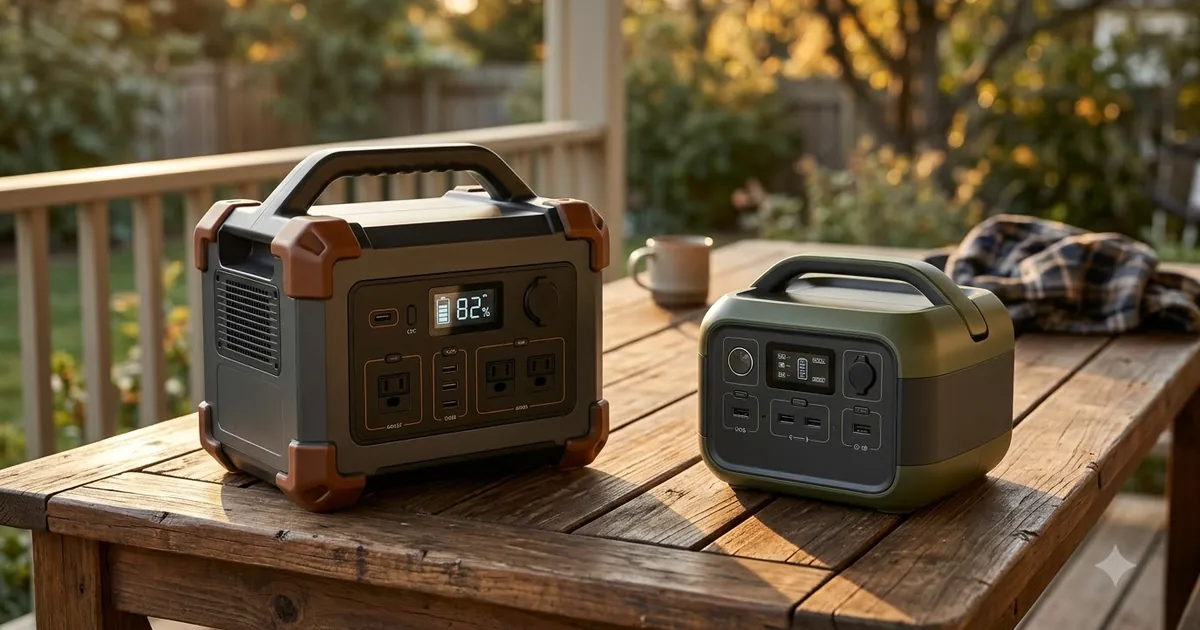
Related picks on Amazon


As an Amazon Associate I earn from qualifying purchases. Availability changes, so check the listing.
This guide is based on manufacturer specifications, published information and buyer feedback. We do not claim hands-on testing. Always follow the instructions that come with your own equipment.
Both store energy, but they are built for different jobs.
| Feature | Power bank | Portable power station |
|---|---|---|
| Typical capacity | Roughly 20-100 Wh | Roughly 200 Wh to several thousand Wh |
| Outlets | USB ports, sometimes a DC port | AC outlets, USB-C, USB-A, car port |
| Runs | Phones, tablets, some laptops | Laptops, TVs, small appliances, a fridge on larger units |
| Weight | Pocket to bag size | Several pounds to over 60 pounds |
| Air travel | Usually allowed within limits | Usually exceeds airline limits |
Which to choose
- Daily phone and laptop top-ups: power bank.
- Camping, outages, remote work or appliances: power station.
Learn what size power station you need.
Frequently asked questions
Can a power bank run a laptop?
Some can, if they support enough USB-C power delivery wattage.
Can a power station charge a phone?
Yes, through USB ports or an AC adapter.
Power Station or Power Bank: How to Choose
Both store energy in a battery, but they are built for different jobs. Capacity and output are the main differences.
- Power bank: small and light, made for phones, tablets, earbuds and sometimes laptops over USB. Capacity is usually measured in milliamp-hours, and there is rarely an AC outlet.
- Power station: larger, with AC outlets, DC ports and often solar input. Capacity is measured in watt-hours and it can run small appliances, CPAP machines, lights and tools.
Quick decision guide
- Only charging phones and a tablet on a trip: a power bank is enough.
- Working remotely, camping with a fridge or lights, or preparing for outages: a power station fits better.
- Flying often: a power bank within airline limits is far easier to carry.
How do I compare milliamp-hours with watt-hours?
Multiply milliamp-hours by the battery voltage and divide by 1,000. Always compare on the same unit before you decide.
Can a big power bank run a laptop?
Some can, if they support USB-C power delivery at the wattage your laptop needs. Check both numbers before buying. For heavier needs, see our budget power station guide.
Ready to buy? Top picks on Amazon
As an Amazon Associate I earn from qualifying purchases. Availability changes, so check the listing.
How fast can each one recharge?
Power banks usually recharge over USB in a few hours, and fast-charging standards can shorten that a lot if both the bank and the charger support them. A power station takes much longer to fill because its capacity is larger, and recharge speed depends on the wall, car or solar input it accepts. Before you plan a trip or an outage, check the input rating in watts, not just the output rating, so you know how long a full charge will take.
Portability in everyday use
A power bank fits in a jacket pocket or a small bag, so it goes with you every day. A power station is built to stay in one place or travel by car, and it may need a cart or two hands to move. Think about how often you will carry it. If the answer is daily, a power bank is the realistic choice. If the answer is only on trips, a power station’s extra energy may be worth the weight.
Flying with batteries
Airlines apply their own rules to lithium batteries, and they often refer to the watt-hour rating printed on the battery or the case. Larger units may be restricted or need approval, and rules differ between carriers and countries. Check the airline’s policy before you pack either device, keep batteries in carry-on luggage where the rules require it, and protect the terminals from contact with metal objects.
Using them together
The two can complement each other. A power station can keep a power bank topped up at a campsite or a home base, and a power bank can cover a phone or earbuds when the station is far away. In an outage, the power station supplies the larger loads while the power bank gives you a small reserve for communication, so you are less likely to run out of phone power at a critical moment.
Checking the label before you buy
- Capacity in watt-hours (Wh), so both types can be compared directly.
- USB output wattage and whether the bank supports USB power delivery.
- Input wattage and the charging time it implies for a power station.
- AC output and surge ratings, for a power station only.
- Warranty and the maker’s safety certification information.
More questions about power banks and power stations
Can I charge a power bank from a power station?
Yes, through a USB port, as long as the cable and the power bank’s input support the charging speed. Many people do this to keep a spare bank ready.
Why does a power bank deliver less than its label figure?
Voltage conversion, cable losses and the device’s own charging behaviour all reduce the usable energy below the stated capacity.
Is a bigger power bank always the better choice?
Not for everyone. Larger units weigh more and may be harder to take on a flight. They are only worth it when you need more energy than a small bank can give.
More guides you may like
Popular buying guides
About the author
The PowerStationWiki editorial team researches portable power stations and solar generators from manufacturer specifications, published reviews and buyer feedback, and writes plain-English buying guides.