
What Can a 1000Wh Power Station Run? Devices and Limits
What a 1000Wh portable power station can and cannot run: lights, router, laptop, TV, refrigerator, tools and appliances, with output limits explained.
 By PowerStationWiki Editors
Updated November 14, 2026
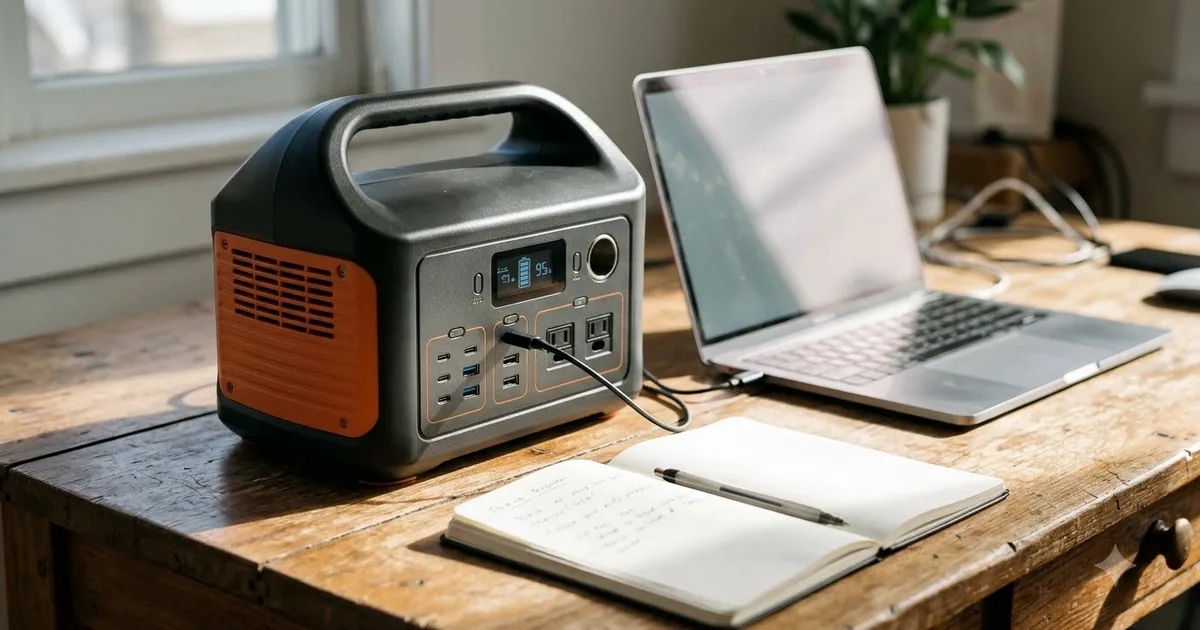
This guide is based on manufacturer specifications, published information and buyer feedback. We do not claim hands-on testing. Always follow the instructions that come with your own equipment.
A 1,000 Wh power station is a popular middle size. It can run many everyday devices, but two limits matter: the total energy (watt-hours) and the maximum output (watts). Heavy heating devices usually exceed both.
Usually fine
- Phones, tablets and laptops
- Wi-Fi router and modem
- LED lights and lamps
- TV and game console
- Fans and small appliances
- CPAP machines in many cases. Check your device manual and speak with your healthcare provider for medical equipment.
- Drone, camera and power-tool battery chargers
Possible with care
- Refrigerator or chest freezer. Depends on running watts and start-up surge. See our refrigerator guide.
- Coffee maker or kettle. Many are 800-1,500 W, which can hit the output limit and drain the battery quickly.
- Small microwave. Works for short use if the output rating allows it.
Usually not suitable
- Electric space heaters
- Electric stoves and ovens
- Clothes dryers and water heaters
- Central air conditioning. A small window unit may be possible only on larger power stations.
How to check any device
- Find the running watts on the label.
- Check that it is below the power station’s continuous output rating.
- If it has a motor or compressor, check the surge watts too.
- Divide capacity by watts for an estimate of runtime. Use our runtime calculator.
Not sure about size? See what size power station do I need and how long a 1000Wh unit lasts.
Typical runtimes for popular devices
| Device | Typical watts | Rough runtime on 1,000 Wh |
|---|---|---|
| Laptop | 60 W | About 14 hours |
| LED TV | 80 W | About 10 hours |
| Router and modem | 15 W | About 55 hours |
| Desk fan | 40 W | About 21 hours |
| Mini fridge | 70 W | About 12 hours of running time |
| Drill charger | 60 W | Many charges |
These are estimates with a typical 85% efficiency. Check your own labels.
Tips for getting more from 1,000 Wh
- Use DC and USB ports for phones and small electronics.
- Run only the devices you really need.
- Charge the unit fully before you need it.
- Add solar if outages could last more than a day.
Watts, watt-hours and what they mean for runtime
Two numbers on the label control almost everything. Watts (W) measure how much power a device draws at any moment. Watt-hours (Wh) measure how much energy the battery holds. Runtime is roughly the battery energy divided by the device’s average power draw, after losses.
The basic formula is simple: runtime (hours) = battery Wh x inverter efficiency / device watts. Inverter efficiency, the share of stored energy that reaches the AC outlet, is often somewhere around 80 to 90 percent, so a 1,000 Wh unit gives roughly 800 to 900 Wh of usable AC energy. Real results vary with load, temperature and battery age.
For example, a 50 W device on a 1,000 Wh unit with about 85 percent efficiency runs for about 17 hours (850 divided by 50). A device that draws 500 W would run for under 2 hours, which shows why high-draw appliances empty a battery so quickly.
Running several devices at the same time
Devices share the battery, so add up their watts before you plug everything in. A phone charger, a laptop, a small LED lamp and a Wi-Fi router together may draw less than 100 W, which a 1,000 Wh unit handles easily for an evening. A fridge that cycles on and off is different, because its average draw is lower than its peak.
A simple way to plan:
- List each device you will run at the same time.
- Add their running watts to get the total load.
- Confirm the total is below the continuous output rating.
- Estimate hours using the formula above, then keep a safety margin of 20 to 30 percent.
Signs you are close to the limit
- The unit shuts off as soon as a motor starts, which points to a surge overload.
- The fan runs loudly and the case feels hot, which suggests a heavy load for a long time.
- The battery percentage drops faster than your calculation predicts, often because of inverter losses or cold weather.
When any of these happen, reduce the load, or move a high-draw device to a battery tool charger or a wall outlet when one is available.
Keeping the unit and your devices safe
Place the power station on a flat, dry surface and keep the vents clear, because the fan needs airflow to keep the electronics cool. Use cords that are in good condition and rated for the load, and avoid daisy-chaining extension cords. Never connect a power station to a home wall outlet to power the house, since this can endanger utility workers and people in the building. Follow the instructions that came with your device for charging, storage and cable use.
How to stretch 1,000 Wh further
- Use the DC and USB outputs when they suit the device, since they skip the inverter losses.
- Turn off the AC output when nothing is plugged into it.
- Keep the unit out of direct sun and heat, because temperature reduces usable capacity.
- Start from a full charge, and recharge before the battery gets too low for your next outage.
Frequently asked questions
Can I plug a power strip into a power station?
Yes, as long as the total load stays within the output rating and the strip is rated for the load.
Can I run power tools?
Many corded tools have high start-up surges. Check the tool’s watts against the unit’s surge rating, or use battery tool chargers instead.
Does the output use up more battery?
Yes. Higher loads drain the battery faster, and the AC output itself uses some power while on.
What is the difference between watts and watt-hours?
Watts measure the rate of power use, while watt-hours measure total energy. A device rated at 100 W running for 3 hours uses 300 Wh.
Can a 1,000 Wh unit run a device for a full day?
Only if the average draw is low. At about 40 W of average load, the usable energy lasts around 20 hours, so a full day is realistic for light loads only.
Why does the battery drop faster than my estimate?
Inverter conversion, standby draw, cold temperatures and an aging battery all reduce the usable energy below the label figure.
Medical equipment: if you plan to run a CPAP machine or other medical equipment from a portable power station, check the device manufacturer’s guidance first and keep a backup plan. A power station is not a medical-grade or guaranteed uninterruptible power source, and this guide is not medical advice.
More guides you may like
Popular buying guides
About the author
The PowerStationWiki editorial team researches portable power stations and solar generators from manufacturer specifications, published reviews and buyer feedback, and writes plain-English buying guides.