
Solar Generator vs Gas Generator: Cost, Noise and Runtime
Solar generator vs gas generator compared on noise, fuel, runtime, maintenance and safety, with advice for outages, camping and off-grid use.
 By Solar & Safety Desk
Updated November 14, 2026
This guide is based on manufacturer specifications, published information and buyer feedback. We do not claim hands-on testing. Always follow the instructions that come with your own equipment.
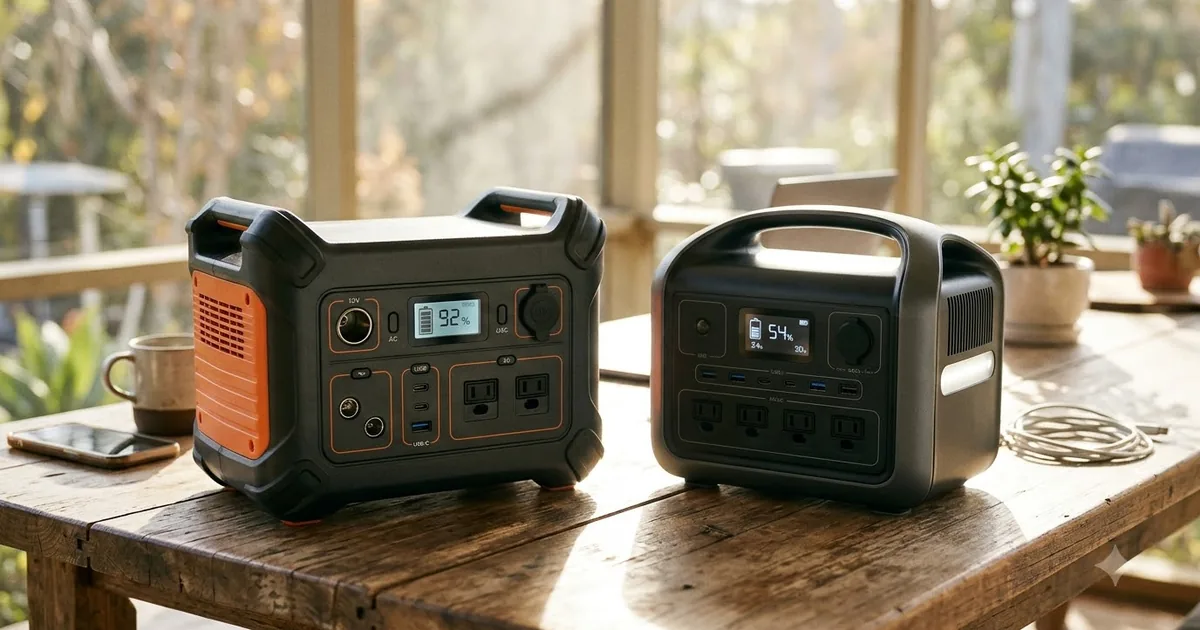
A “solar generator” is usually a portable power station sold together with solar panels. A gas generator burns fuel. They suit different situations.
The short answer
Choose a solar generator if your needs are modest: phones, laptops, Wi-Fi, lights, a fridge, or camping gear. It is quiet, has no exhaust and needs almost no upkeep.
Choose a gas generator if you must run heavy loads for days, such as a well pump, central air or an electric range, and you can store fuel safely. If your needs fall in between, a power station for essentials plus a generator for heavy loads is a common setup.
Comparison
| Feature | Solar generator | Gas generator |
|---|---|---|
| Noise | Nearly silent | Loud |
| Fuel | Sunlight, wall power | Gasoline or similar, must be stored |
| Runtime in a long outage | Limited by battery and sunlight | As long as you have fuel |
| Heavy loads | Limited, unless very large | Higher output |
| Maintenance | Minimal | Oil, filters, fuel care |
| Safety | No exhaust; lithium battery care | Carbon monoxide risk, run outdoors only |
Quick reference: typical ranges
These are typical ranges only. Check your own label and manual, because models vary widely.
| Item | Typical range | Why it matters |
|---|---|---|
| Small power station capacity | Hundreds of Wh up to about 1,000 Wh | Covers phones, laptops, routers, lights |
| Large power station capacity | About 1,000 to several thousand Wh | Can carry a fridge or some tools for hours |
| Portable gas generator output | Roughly 1,000 to 10,000+ W | Higher output for heavy appliances |
| Single solar panel (portable) | Roughly 50 to 400 W rated | Real output is usually well below the rating |
| Fridge running power | Often 100 to 200 W, with a higher start-up surge | Check the appliance label |
Worked example: sizing a solar generator
Use these formulas:
- Wh = W x hours (energy needed)
- Battery needed = Wh x 1.2 (allow roughly 15-20% conversion loss)
- Daily solar Wh = panel W x sun hours x 0.75 (about 25% real-world loss is a common rule of thumb)
Say you want to run 150 W of combined loads (a fridge, router and a few lights) for 8 hours.
- 150 W x 8 h = 1,200 Wh
- 1,200 Wh x 1.2 = about 1,440 Wh of battery capacity
Now say you have a 200 W panel and about 4 peak sun hours.
- 200 W x 4 h x 0.75 = about 600 Wh per day
In this example the panel would replace roughly 40% of what the 8-hour load used. Cloudy weather lowers that further. For panel counts, see how many solar panels you need.
Gas generator runtime: how to estimate it
Gas runtime depends on fuel tank size and load. A rough formula is hours = fuel capacity ÷ fuel use per hour. Fuel use per hour is listed in the manual, often at 25%, 50% and full load. Lighter loads usually burn less fuel per hour.
How to choose: step by step
- List what you must power: fridge, router, medical or work devices, lights.
- Find each device’s watts on its label. Note any start-up surge for motors and compressors.
- Add the running watts to get your total load. Compare it to the continuous output rating of the unit.
- Estimate hours of use per day and apply Wh = W x hours.
- Add the 15-20% loss allowance to find battery size.
- Decide how long outages usually last where you live. Multi-day outages with heavy loads favor fuel.
- Consider noise rules, storage space and who will maintain the equipment.
Common mistakes
- Confusing watts (power) with watt-hours (energy).
- Ignoring start-up surge on fridges, pumps and tools.
- Assuming a panel’s rating equals what you get. Angle, shade, heat and clouds all reduce output.
- Expecting a small power station to run heaters, ovens or large air conditioners.
- Storing fuel for years without rotating it or using stabilizer as the manufacturer directs.
- Never test-running a generator before an outage.
Safety notes
- Run a gas generator outdoors only, far from doors, windows and vents. Exhaust contains carbon monoxide, which you cannot see or smell. A battery-powered carbon monoxide alarm indoors is widely recommended.
- Let a gas generator cool before refueling, and store fuel in approved containers away from ignition sources.
- Never plug a generator into a wall outlet to power the house. Use a properly installed transfer switch, fitted by a licensed electrician.
- Keep power stations away from heat and water, and follow the manufacturer’s charging and temperature limits.
- Do not use damaged cables, and use extension cords rated for the load.
Which to pick
- Pick solar for quiet, low-maintenance backup of essentials and for camping.
- Pick gas for long outages with heavy loads and when you can store fuel safely.
Read power station vs generator and how many solar panels you need.
Frequently asked questions
Can a solar generator run indefinitely?
In theory, if the sun recharges the battery as fast as you use it. In practice, runtime depends on panel size and weather.
Is a solar generator the same as a power station?
The power station is the battery unit. A solar generator usually adds panels.
Can a solar generator run a refrigerator?
Often yes, if its continuous output covers the fridge’s running and surge watts and the battery holds enough Wh for the hours you need. Check the fridge label and the power station’s ratings.
Is a solar generator quieter than a gas generator?
Generally yes. A power station may have a small cooling fan under load, but it has no engine, so it is far quieter than a gas unit.
Can I use a solar generator indoors?
Power stations produce no exhaust, so they are commonly used indoors, with ventilation and heat limits per the manual. Gas generators must never run indoors, in garages or near open windows.
More guides you may like
Popular buying guides
About the author
The Solar & Safety Desk covers solar panels, charging, lithium battery safety and recalls, citing manufacturer instructions and official sources such as the CPSC.